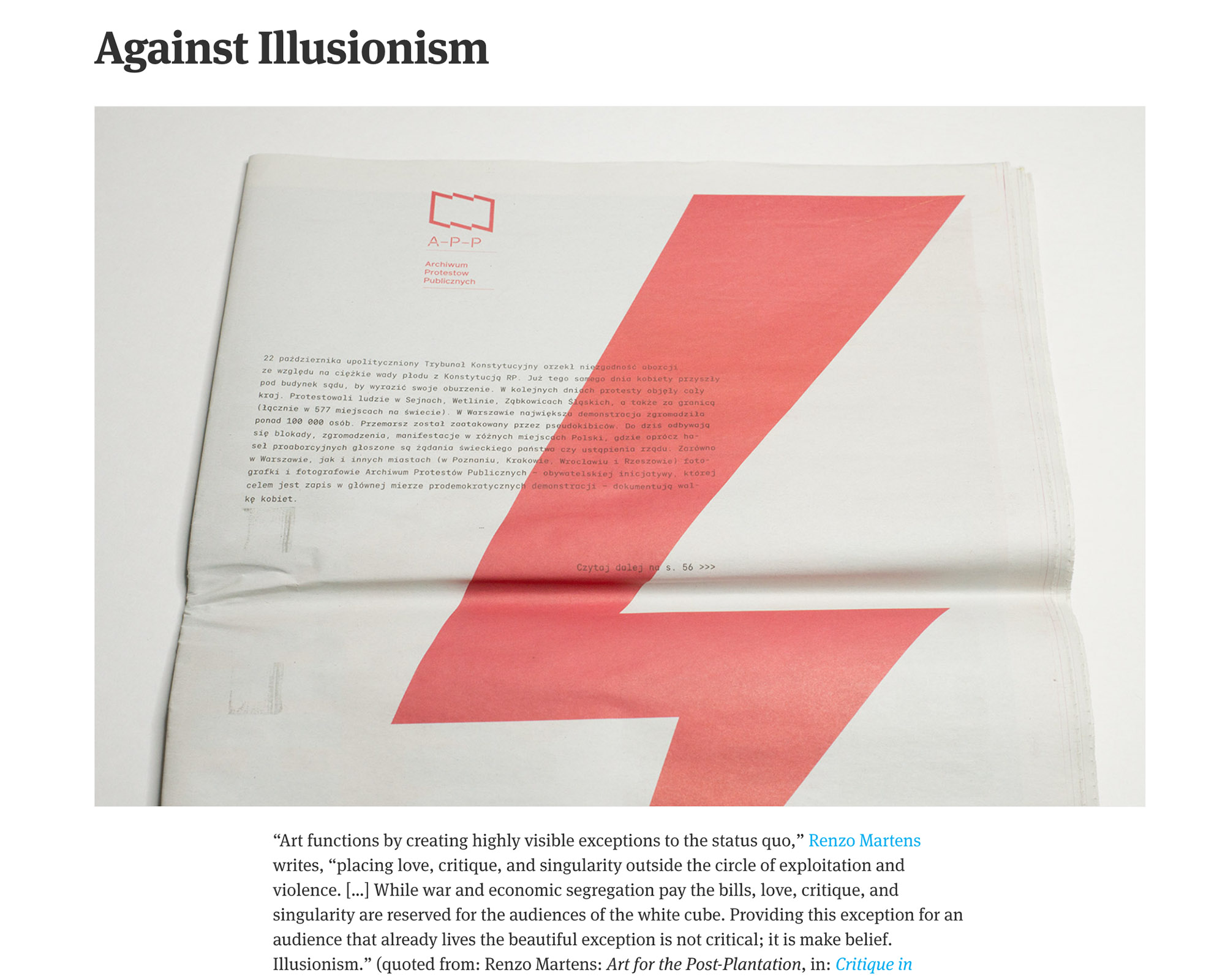
“Art functions by creating highly visible exceptions to the status quo,” Renzo Martens writes, “placing love, critique, and singularity outside the circle of exploitation and violence. […] While war and economic segregation pay the bills, love, critique, and singularity are reserved for the audiences of the white cube. Providing this exception for an audience that already lives the beautiful exception is not critical; it is make belief. Illusionism.” (quoted from: Renzo Martens: Art for the Post-Plantation, in: Critique in Practice: Renzo Martens’ Episode III: Enjoy Poverty, ed. Anthony Downey, Sternberg Press, 2019, p. 330)
The world of the photobook is not one we associate with the white cube — photobooks are typically enjoyed in the privacy of one’s home. Yet it is not hard to think of a photobooks bringing the white-cube mindset to people’s homes, one book at a time. We might replace a few words in Martens’ statement — “photobooks” for “art,” say, to arrive at a valid and searing indictment of much of what ills the world of the photobook as well.
Most photobooks dabble in illusionism.
This illusionism is caked into the larger world of art, of which photoland has become a niche. Things are said and shown one way, yet they really mean something entirely different when seen in the contexts in which they are made to appear.
The very first advertising in the most recent edition of Aperture‘s magazine (#245), a colourful double-page spread, presents Gucci, the luxury fashion house. Assorted other luxury brands (incl. Leica) follow. So when viewers then see a photograph by William Camargo entitled We Gonna Have to Move Out Soon Fam! (Anaheim, 2019), showing a person holding a large sign that says “THIS AREA WILL GENTRIFY SOON”, what are they supposed to make of it?
Of course, this is a Gedankenexperiment on my part, because the ads don’t target the likes of me who begrudgingly shop at Walmart, given their limited economic options.
What does the latter have to do with the former? Martens explains: “If art takes responsibility for its entanglement with circuits of capital and exploitation, then it goes beyond the production and display of mere images.” (ibid.)